
JUNE 23, 2024 BY ROCKY KISTNER
Kistner Special to the Post-Dispatch
This story was commissioned by the River City Journalism Fund.
ST. LOUIS — Robin Proudie remembers working concessions at the old Busch Stadium as a teenager, selling popcorn and peanuts to hungry baseball lovers. Her favorite memory is the seventh game of the Cardinals’ 1982 World Series. After the final out, she joined hundreds of frenzied spectators who poured onto the field to congratulate the new champs. She remembers star shortstop Ozzie Smith picking her up in celebration.
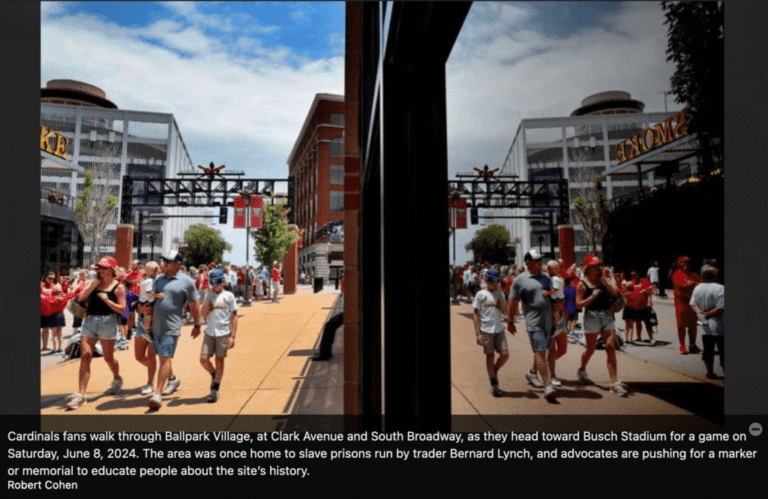
But there is a part of Busch Stadium history that Proudie only recently learned about, a dark history linked to the building that was so dear to her. Historians say some of St. Louis’ most notorious slave prisons — known as the Lynch slave pens — sat near the intersection of South Broadway and Clark Avenue, where the new Busch Stadium, Ballpark Village, and the InterPark Stadium East garage are now clustered.
Thousands of men, women, and children were held in Bernard M. Lynch’s underground slave prisons before the Civil War, incarcerated in rooms with dirt floors, no beds, and bars on the windows. Some were chained to basement cells, waiting to be sold to local buyers or “downriver” to work in cotton and sugar cane fields.
Remnants of the prison cells survived in the basement of a large drug company warehouse and office building until it was torn down in 1963 to make way for the baseball stadium where Proudie worked as a teen.
“I had no idea…I’ve parked in that garage,” said Proudie, founder and executive director of the nonprofit Descendants of the St. Louis University Enslaved. “This is hallowed ground with people’s souls. It needs to be acknowledged publicly that their lives mattered.”
