
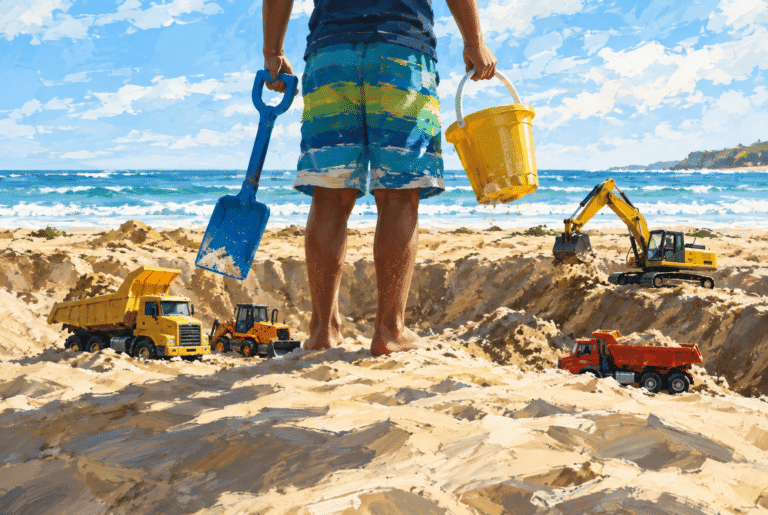
An investigation by journalist David Taylor and illustrator Mark Smith for Scientific American takes readers deep inside the criminal world of sand mafias operating in Morocco and other African countries, part of a massive illegal global trade worth hundreds of billions of dollars. Their story reports on the illicit trade’s devastating environmental impacts, stripping away natural sand barriers that hold and contain water, with huge effects on people’s lives. The 2024 project took third place for outstanding feature story, large, for the Society of Environmental Journalists’ 23rd Annual Awards for Reporting on the Environment.
SEJ judges were particularly impressed with the story’s revelations about a massive illegal enterprise that rarely gets media coverage: “This riveting piece takes the reader on a journey into North Africa, and a too-often overlooked black market, whose shady size and scale are estimated to sit just behind counterfeiting and drug trafficking and far ahead of the illegal mining of other elements. The reporter built upon established relationships and experience to explore a curious corner of the environment, importantly laying a foundation of work that other environmental reporters might be wise to begin to build upon.”
SEJournal’s Inside Story interviewed journalist David Taylor about the project. Here’s the conversation, lightly edited for clarity and style by Inside Story Co-Editor Rocky Kistner.
SEJournal: How did you get your winning story idea?
David Taylor: By following up with my sources for a wildlife trafficking story I reported the year before. I emailed them saying, basically, “Thanks for your help last year. Is there an area of trafficking that strikes you as ripe for follow-up?” One replied, “Sand mafias. It’s a major problem in Africa, the Far East and elsewhere.” That stunned and intrigued me.
SEJournal: What was the biggest challenge in reporting the piece and how did you solve that challenge?
Taylor: I found knowledgeable sources, but how could I go and report scenes from illegal mines so far away? Freelancers often face the challenge of travel budget. I urged my editor to support travel, but for this story centered on northern and eastern Africa, I had to rely on extensive, in-depth video interviews, adjacent literature, my personal experience of those regions and extra sourcing on the social and political settings. Getting good imagery was also a challenge, resolved in part by an excellent illustrator.
SEJournal: What most surprised you about your findings?
The convergence of organized crime
with environmental crime created
what one legal expert called
‘a Noah’s Ark of criminality.’
Taylor: Everything, but first was the scale of sand trafficking. The convergence of organized crime with environmental crime created what one legal expert called “a Noah’s Ark of criminality.” Illegal sand for construction outpaces wildlife and logging combined. Second was the corruption. My source in northwestern Africa described how, after being waved away from a coastal sand mine by police, he went higher to see from cliffs above. He looked out on a pocked moonscape with a half dozen huge trucks piled high with sand. A crime scene in broad daylight. He admitted that the irony of openly stealing a public good shocked even him. The corruption was “top to bottom.”
SEJournal: How did you decide to tell the story?
Taylor: I had had a series of good interviews with a key source on North Africa, researcher Abdelkader Abderrahmane, and at first I expected the story would center on him, supported with a global perspective from physical geographers. Then one conversation pointed me to a Kenyan-born scientist, Halinishi Yusuf, whose experience and knowledge complemented his. She grew up in a rural county outside Nairobi, and it became clear that her personal experience offered a compelling picture of the criminal syndicates’ violent growth, and one example of how to defuse them. So I recast the story, anchored by their two narratives.
SEJournal: Does the issue covered in your story have disproportionate impact on people of low income, or people with a particular ethnic or racial background? What efforts, if any, did you make to include perspectives of people who may feel that journalists have left them out of public conversation over the years?
Marginalized communities and groups
are most vulnerable to trafficking’s
damage, both in lost livelihoods and
violent reprisals, and in exposure
to rising sea levels on coasts.
Taylor: Yes, marginalized communities and groups are most vulnerable to trafficking’s damage, both in lost livelihoods and violent reprisals, and in exposure to rising sea levels on coasts. Both of my main storytellers came from those backgrounds. Yusuf especially provided the perspective of fighting the menace of crime and ignorance from within her community. Getting her inside view made the story vivid and showed the agency and courage that came from there.
SEJournal: What would you do differently now, if anything, in reporting or telling the story and why?
Taylor: I would apply earlier for grant support to report a story that is international in scope.
SEJournal: What lessons have you learned from your story or project?
Taylor: It reinforced for me the principle of following up with my network of sources to get their ideas, and framing pitches to surprise readers and editors.
SEJournal: What practical advice would you give to other reporters pursuing similar projects, including any specific techniques or tools you used and could tell us more about?
Taylor: On environmental crime, you find resources from organizations like UNICRI, ISS Africa and the FACT Coalition. For example, a 2024 FACT report on money laundering analyzes more than 200 environmental crimes in the Amazon region across a decade to show how profits get laundered. That helps reporters follow the money.
SEJournal: Could you characterize the resources that went into producing your prizewinning reporting (estimated costs, i.e., legal, travel or other; or estimated hours spent by the team to produce)? Did you receive any grants or fellowships to support it?
I recommend that freelancers
apply for research grants from
professional associations and
other sources as soon as they can.
Taylor: The hours spent to produce the reporting really added up. Through the months of research, iteration and revision with the editors, it took much of my freelance time. I did not have the benefit of grants or fellowships in this period. In the past, my work has been supported by grant programs that no longer exist in the same way, including the International Reporting Project and CASE. I recommend that freelancers apply for research grants from professional associations and other sources as soon as they can.
SEJournal: Is there anything else you would like to share about this story or about environmental journalism that wasn’t captured above?
Taylor: Just that SEJ and its members are a rich resource for ideas and support. I’ve submitted work for the SEJ awards for over a decade, knowing it was a long shot. But receiving this award shows that you shouldn’t count yourself out by not submitting.
David Taylor is a freelance writer for Scientific American, The Washington Post, Discover, Smithsonian and others. His books include “Ginseng, the Divine Root” (Algonquin) about a medicinal plant’s odyssey; and “Cork Wars: Intrigue and Industry in World War II” (Johns Hopkins Press) about an episode in environmental security, which received an Independent Publisher Book Award for world history. He loves documentary film and writes for podcasts including “The People’s Recorder,” which received a 2025 Signal Award. He was a 2025 Fulbright U.S. scholar, researching and teaching climate journalism with Lisbon Polytechnic. He’s an adjunct professor with the Johns Hopkins Science Writing Program and lives in Washington, D.C.
