
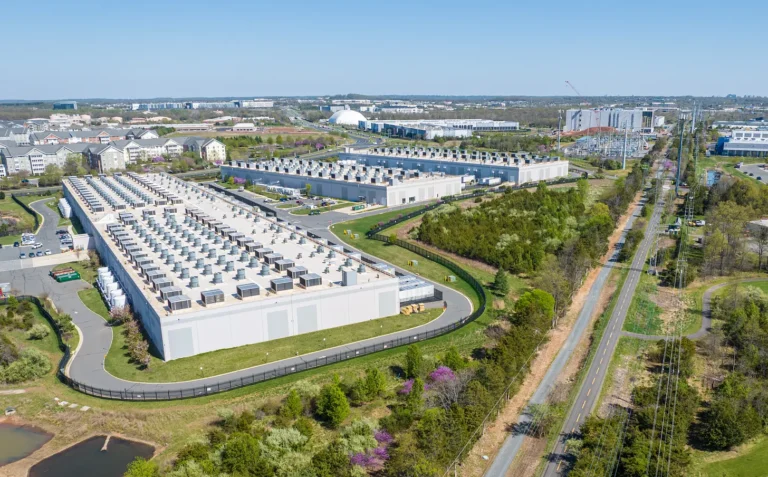
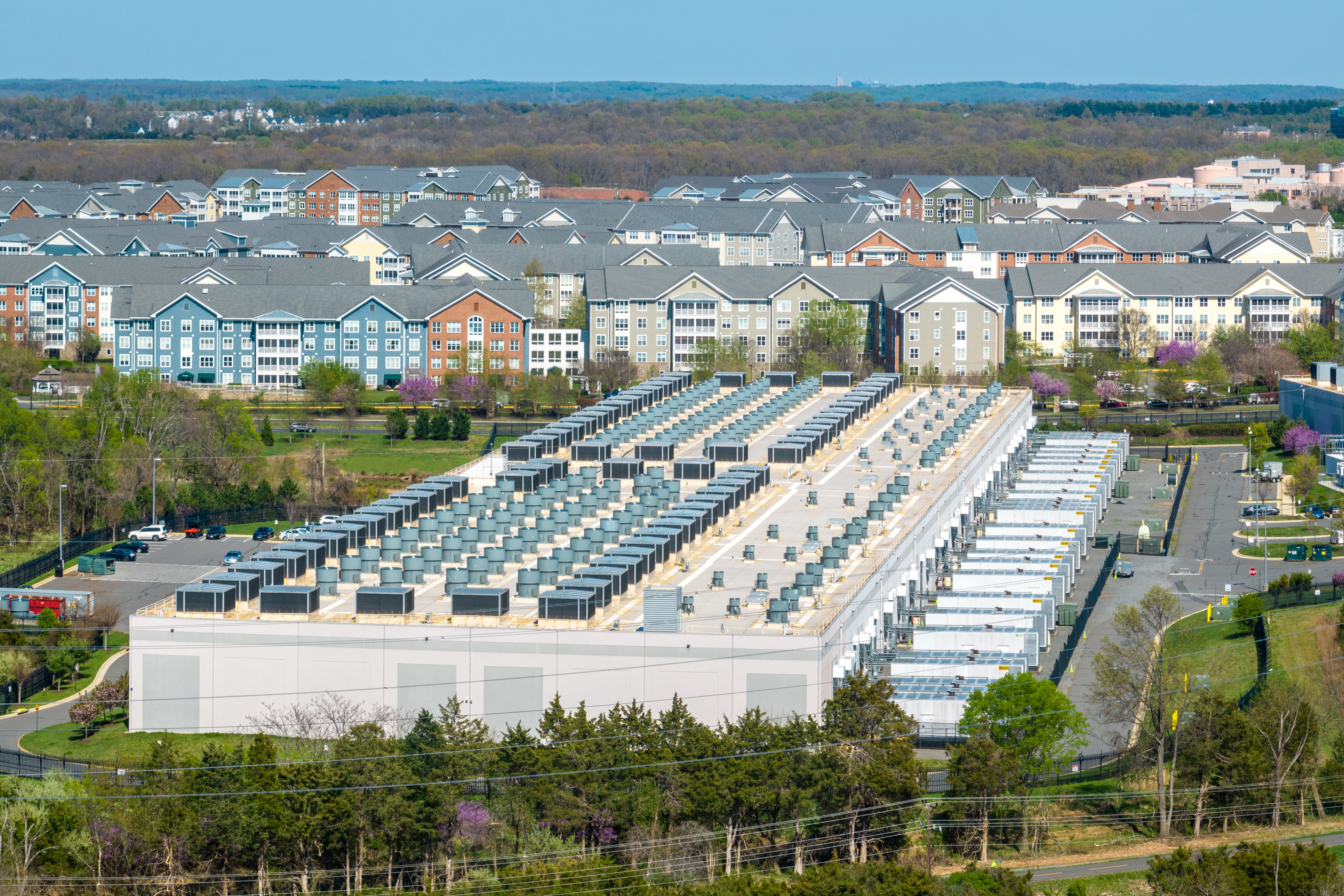
Just outside the nation’s capital along Northern Virginia’s rapidly expanding Dulles business corridor are more than 300 low-slung concrete buildings that represent the largest concentration of hyperscale data centers in the world. Here little-known companies, including CyrusOne, Digital Realty, Equinix and Vantage Data Centers, maintain the “cloud,” the massive repository of bits and bytes that contain the web’s growing data library. At least 70 percent of the world’s internet traffic runs through Northern Virginia alone.
The companies that comprise what locals call “data center alley” may not have household names, but the corporations that rely on them do. They include Amazon, Google and Microsoft, all of which would be unable to function without these data centers. Americans who use cell phones, play computer games, and surf digital platforms every day would have a hard time without them, too.
The skyrocketing growth of data centers in Northern Virginia dates back to the early days of America Online (now AOL), a pioneer of the internet revolution, as well as to the buildout of the fiber optic industry that evolved with the demands of the federal government and military contractors. Local Virginia communities’ pro-growth agenda see data centers as a moneymaker that expands their tax base, so they awarded tech companies major tax breaks to lure them to the area.
Money Trail is a reader-supported publication. To receive new posts and support our work, consider becoming a free or paid subscriber.Subscribe
There is little doubt that the data centers have boosted the local economy, but given they don’t employ large numbers of permanent workers, much of that growth is due to construction, which only provides a temporary shot in the arm. A report released last year by Virginia’s Joint Legislative Audit and Review Commission (JLARC) acknowledged as much. “Overall, the data center industry is estimated to contribute 74,000 jobs, $5.5 billion in labor income, and $9.1 billion in GDP to Virginia’s economy annually,” it found. “Most of these economic benefits derive from the construction phase rather than data centers’ ongoing operations.”
Data Centers’ Dark Side
Besides the fact that the data industry’s explosive growth will likely have a limited positive economic impact, it has a dark side that is beginning to attract public attention. Data centers use massive amounts of water to cool their computer systems, for example, which puts pressure on local water supplies. Likewise, their computer servers require enormous amounts of energy, which they get from either fossil gas or diesel generators. That means more toxic and carbon pollution. Some electricity providers are even considering extending the life of their heavily polluting coal-fired power plants instead of closing them as planned to meet their climate goals.
In addition, “data centers’ increased energy demand will likely increase system costs for all customers, including non-data center customers,” according to the JLARC report. Data centers also will strain the electric grid unless grid operators and federal and state governments take action. Failing to invest billions of dollars in the grid “in a timely manner would force regulators to acquiesce to rate increases of as much as 70 percent in the next decade in order to ensure that the grid functions properly and provides energy to all uses,” a 2024 report by the Jack Kemp Foundation and Capital Policy Analytics warned. “The consequences of such a failure could be the appearance of regular brownouts and blackouts in Northern Virginia and across the country.”
It won’t be easy to check the growth of data centers or the resulting rate increases. The electric power industry nationally has undue influence over statehouses and public energy commissions. Dominion Energy—Virginia’s largest power provider—is by far the state’s biggest political donor, contributing nearly $12 million to candidates and political action committees since 2024, nearly three times the next highest donor.
Northern Virginia governments have not been transparent about the sweetheart deals they have given the data centers, says Chris Miller, president of the Warrenton-based Piedmont Environmental Council. What many Virginians don’t realize, Miller says, are the rising costs of tax breaks to encourage data centers to locate to the area. Ratepayers ultimately will have to pay for them out of their pockets.
“We need to get this right or it will be like it was in the 1950s when people were wondering why the rivers were catching on fire,” Miller told Money Trail. Tech companies, he says, are “breaking all the systems and they should pay to fix it…. It’s a direct subsidy for [some of] the … richest companies in the world.” He pointed out that one local power provider, Rappahannock Electric Cooperative, expects a 445 percent increase in electricity demand by 2030. That would mean more power plants, mostly fueled by fossil gas or coal.
The Sierra Club’s Virginia chapter released a report in June documenting the impact of the data centers on the region. It found that:
- Carbon emissions in Loudoun County have jumped 50 percent in recent years.
- A single data center can consume 5 million gallons of water a day, enough to supply 50,000 people. In 2023 alone, Virginia data centers used more than 2 billion gallons of water.
- Energy demand in Virginia has increased over the past three years and is expected to continue. One data center in Henrico’s White Oak Technology Park will require as much energy as New York City’s borough of Manhattan.
- Data centers are encroaching on residential areas, with 70 percent in Fairfax County now located within 500 feet of private homes.
- With more than 400 million square feet proposed, built or under construction, Virginia, which now hosts 600 data centers statewide, could be become the home of as many as 1,300 of them in the coming years.
“Virginians are subsidizing the world’s internet, cloud services and artificial intelligence applications, and paying for the infrastructure and energy that serve global corporations,” the report concluded, “while reaping few local benefits.”
A National Problem
A number of news organizations, state governments, and federal and international agencies concur that data centers pose major problems nationwide.
In December 2024, for example, the Department of Energy reported that data centers consumed 4 percent of total U.S. electricity in 2023 and projected they would eat up 7 to 12 percent by 2028. Meanwhile, in April, the International Energy Agency projected that U.S. data centers would make up half the growth in energy demand by 2030.
As the Virginia Sierra Club found, this growth is threatening local water supplies. According to a May Bloomberg News report, the problem will likely intensify nationally given that two-thirds of new data centers built or planned since 2022 are in areas that already have compromised water resources.
Particularly at risk are Virginia’s climate emission reduction goals. Dominion Energy projects that data centers will boost energy demand over the next 15 years, which would make it difficult for the company to meet its goal to decarbonize its electricity grid by 2045. “Year after year, Dominion files plans that ignore clean energy requirements, lock in expensive fossil-fuel infrastructure, and drive up electric bills,” Dayanna Jaye with the nonprofit environmental group Clean Virginia told Canary Media in July.
For its part, Dominion claims its clean energy goals have not changed. “We are not taking our foot off the accelerator with renewables,” a Dominion spokesperson told Inside Climate News last year. “The clean energy transition is more challenging than it was a few years ago,” he added. “The inescapable reality is we are experiencing unprecedented growth in electric demand.”
Renewables, which could help meet growing demand, are now facing headwinds. Since Donald Trump took office, his administration has cancelled billions of dollars in clean energy projects across the country. It’s likely those cancellations will continue, granting life extensions to fossil fuel sources that power data centers. In July, the business group E2 reported that Trump administration’s policies have thus far resulted in the cancellation of $22 billion worth of renewable projects, leading to the loss of 16,500 jobs.
Data center advocates see no end to their growth, which they contend will provide jobs and revenue to cash-starved communities. But others see potential dangers ahead as the industry expands with few guardrails. And some experts say the industry’s burgeoning development is not only bad news for ratepayers’ bills, but it’s also bad news for ratepayers’ health.
A column in the upcoming September issue of the peer-reviewed journal Eco-Environment & Health warns that data centers’ health impact has been largely overlooked and should be investigated, while a June Business Insider investigation reported that “[f]ossil-fueled power plants and diesel backup generators that power data centers emit hazardous pollutants such as nitrogen oxides and fine particulate matter, increasing rates of respiratory diseases, cardiovascular conditions, and elevating cancer risk in nearby communities.” It found that health care costs associated with air pollution from data center electricity demand could zoom as high as $5.7 billion to $9.2 billion annually.
Besides the higher cost of electricity, groups like the Piedmont Environmental Council say that’s the true cost of the data center revolution.
Rocky Kistner, Money Trail’s associate editor, previously worked as a reporter and producer at ABC News, the Center for Investigative Reporting, HuffPost, Marketplace and PBS Frontline.
Money Trail is a fiscally sponsored project of the Alternative Newsweekly Foundation, a 501(c)(3) public charity, EIN 30-0100369. Donations are tax-deductible to the extent allowed by law.
