
A new comprehensive 2026 State of the Climate report by some of the world’s top climate scientists warns that nearly half of Earth’s 16 climate-related key indicators are at record extremes, showing evidence of accelerating trends that increase worries about climate instability, interacting feedbacks and increasing the risk of crossing critical tipping points. “Earth’s climate system is moving deeper in uncharted territory,” the scientists wrote. “We are witnessing the rapid destabilization of the Earth’s climate system. This is no longer a warning for the future; it is a diagnosis of the present.”
The report covers a wide range of climate indicators, which raise alarms about possible acceleration of climate risks now and in the future. These include:
- Concentrations of the three most important greenhouse gases, carbon dioxide, methane, and nitrous oxide, all reached record levels again in 2026. In May of 2026, atmospheric CO2 concentration exceeded 428 ppm, which is ∼50% greater than pre-industrial levels. These rising greenhouse gas concentrations, largely generated by burning fossil fuels, continue to intensify Earth’s energy imbalance and long-term warming.
- Glacier thickness and Greenland ice mass are now at record lows. In recent decades, the Greenland ice sheet has undergone a series of intense melting episodes contributing to a sixfold increase in extreme summer meltwater volume. In addition, minimum Arctic sea ice extent and Antarctic ice mass change are also near record extremes.
- The oceans continue to absorb the vast majority of excess heat generated by greenhouse gas emissions. Based on preliminary data, ocean heat content and sea level are at record highs. Ocean heat content is rising at an accelerating rate, and the resulting thermal expansion of seawater accounts for approximately 56% of the global sea level rise observed in recent decades. Marine heatwaves have also increased in frequency and intensity, contributing to coral bleaching, ecosystem disruption, and regional climate extremes.
- Fossil fuel consumption increased by 0.9% in 2025, with oil (+1.0%), coal (+0.4%), and gas (+1.3%) all reaching record highs. There was also a rise in annual energy-related CO2 emissions, which surpassed 41 Gt for the first time. Also in 2025, solar and wind energy consumption increased by approximately 18%. Although this growth was rapid, renewables still represented a much smaller share of total energy consumption than fossil fuels. Continued growth in global energy demand meant that renewable expansion was insufficient to displace fossil fuel consumption, resulting in record levels of both fossil fuel use and CO₂ emissions.
- Tropical primary forest loss decreased by 36% in 2025 compared to 2024. The deforestation rate in the Brazilian Amazon rainforest decreased for the fourth straight year in a row, reaching its third lowest level in 38 years…Record heat is increasing carbon dioxide released by plants, soils, and other living organisms, a trend likely to become more pronounced under future climate change and further reinforce global warming.
- Beyond gradual climatic change, growing evidence suggests that the climate system may be entering a period of increasing instability characterized by accelerating warming, cascading feedbacks, tipping elements, and rising risks of irreversible change. Increasing energy imbalance, rising ocean heat content, weakening carbon sinks, and accelerating ice loss all point toward a climate system accumulating heat and stress at rates that may exceed earlier expectations. Extreme weather is also intensifying across many regions of the world, demonstrating how climate change is increasingly affecting people’s daily lives. Recent years have brought increasingly destructive heatwaves, floods, droughts, storms, and wildfires that are causing growing losses of life, infrastructure, food security, biodiversity, and economic stability.
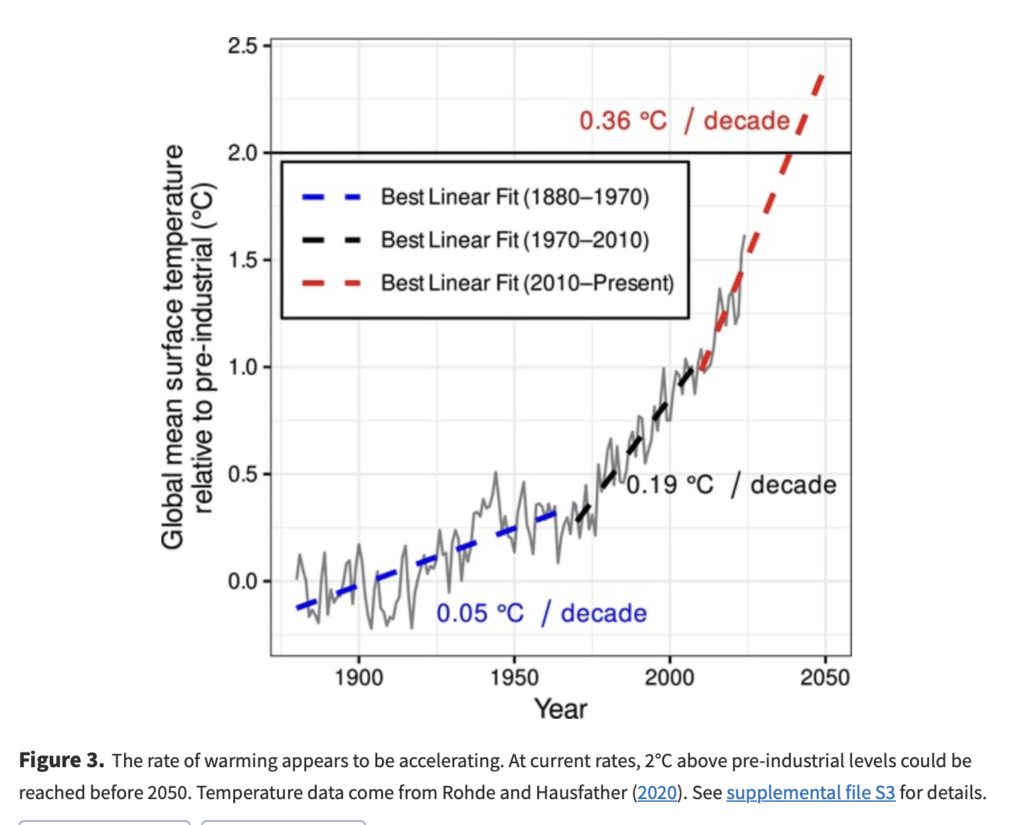
- The rate of global warming appears to have accelerated, rising from ∼0.05°C/decade between 1880 and 1970 to ∼0.19°C/decade between 1970 and 2010, and finally to ∼0.36°C/decade between 2010 and 2024. A similar acceleration has been found to be statistically significant since roughly 2015. The acceleration may be partly related to reductions in aerosol pollutants that previously masked a portion of greenhouse gas warming. Faster warming could compress adaptation timelines, increase the likelihood of crossing tipping thresholds, and reduce the margin for avoiding irreversible impacts. On the other hand, other analyses find that the observed warming, including the 2023–2024 global temperature spike, is consistent with state-of-the-art climate model simulations. Even if warming is closely tracking model projections, key impacts such as the rise in extreme weather events may not be well captured by the models.
- Growing concern also surrounds the destabilization of climate tipping elements. The Atlantic Meridional Overturning Circulation (AMOC), which transports warm water northward and cold water southward, may be particularly important because of its interactions with other tipping elements. Melting of Arctic sea ice and the Greenland ice sheet may weaken the AMOC, which could alter precipitation patterns, disrupt marine ecosystems, and increase drying in parts of the Amazon rainforest.
- Globally, recent estimates suggest that amplifying climate feedbacks involving warming-induced greenhouse gas emissions from natural sources including permafrost, wetlands, freshwaters, and wildfire could increase post-2020 anthropogenic warming by roughly 20%–30% by 2100. Continued warming and interacting feedbacks may increase the risk of a self-reinforcing “hothouse” trajectory characterized by weakening carbon sinks, accelerating ice loss, ecosystem degradation, and additional greenhouse gas release. Although substantial uncertainties remain, recent observations suggest that some climate-system changes may already be unfolding faster than expected.
A daunting challenge, but solutions are at hand.
This is a challenging list of climate impacts, and experts say they could all worsen if we don’t change paths and quickly adopt clean energy sources that would cut the emissions of fossil fuels—the number one cause of climate change. The truth is it’s more of a political question than a technical one. Blocking the way is the fossil fuel industry, the most powerful industry on the planet.
But authors of this report say there is real evidence of solutions on the horizon, and rapid improvements in the efficiency of clean energy are already taking place. “Despite escalating climate risks, signs of societal transformation are beginning to emerge. Rapid advances in renewable energy, battery storage, adaptation planning, ecosystem restoration, and climate response tools suggest that large-scale change remains possible.
“The 2026 Santa Marta conference in Colombia marked an important milestone as the first global summit dedicated exclusively to the practical phase-out of fossil fuels (https://transitionawayconference.com/). The meeting established a new international precedent for transitioning away from coal, oil, and gas, involving more than 50 participating nations and 24 formal signatory countries.
“Although current progress remains far below what is needed to stabilize the climate system, the future trajectory of both the climate system and human societies has not yet been fully determined. The decisions made during the coming years will strongly influence whether future generations inherit a planet with an unstable climate system or a more resilient and sustainable world.”
Future generations are counting on leaders to make the right decisions. We have the knowledge and the tools to make a more rapid transition to clean energy and promote more sustainable activities. What we need, experts say, is the political will. It is up to us to hold our leaders accountable.
###